Research
Evaluation of Rodenticide Susceptibility of Endemic Wildlife in "Galapagos of the Orient" the Bonin Islands

Protecting Endemic Wildlife while Controlling Invasive Rodents
The Bonin (Ogasawara) Archipelago was inscribed as a UNESCO World Natural Heritage Site in 2011 because of its unique ecosystems. However, invasive species introduced through human activities, including commensal rodents such as brown rats and black rats, have caused serious problems by preying on endemic species and disturbing the native ecosystem.
Rodents reproduce rapidly, making eradication by cage trapping alone extremely difficult. Therefore, rodenticides, including diphacinone, have been used in the Bonin Islands to control invasive rodent populations. However, the potential effects of these chemicals on the island ecosystem must be carefully evaluated.
In Europe and North America, highly toxic second-generation anticoagulant rodenticides have been widely used, and secondary poisoning of birds of prey that consume poisoned rodents has become an important ecological concern. Furthermore, repeated use of rodenticides can lead to the emergence of rodent populations with reduced susceptibility or resistance to these chemicals, sometimes referred to as “super rats.” In Japan, a high prevalence of anticoagulant rodenticide-resistant rats has also been reported in urban areas such as Shinjuku, Tokyo.
To date, no cases of wildlife mortality due to rodenticide poisoning or the emergence of confirmed rodenticide-resistant rat populations have been reported in the Bonin Islands. Nevertheless, to continue invasive rodent control safely, it is essential to evaluate both the susceptibility of endemic species to rodenticides and the potential development of rodenticide resistance in invasive rodents.
1. Rodenticide Susceptibility Assessment of the Bonin Fruit Bat
A Critically Endangered Species with an Estimated Population of Only 100–200 Individuals
Because the Bonin Islands have never been connected to a continental landmass, the Bonin fruit bat (Pteropus pselaphon) is the only native terrestrial mammal in the archipelago. Its population is estimated at only approximately 100–200 individuals, and it is classified as Critically Endangered (CR) in the Ministry of the Environment’s Red List of Japan.
Anticoagulant rodenticides used in the Bonin Islands are intended to target invasive rodents. However, because mammals share similar physiological mechanisms of blood coagulation, these rodenticides may also exert anticoagulant effects in non-target mammalian species, increasing the risk of bleeding.
Importantly, chemical susceptibility differs among animal species. Even when chemicals act through the same anticoagulant mechanism, some species may be highly sensitive, whereas others may be relatively tolerant. Therefore, the safe use of rodenticides in the Bonin Islands requires an assessment of the susceptibility of the Bonin fruit bat, the archipelago’s only endemic mammal, to anticoagulant rodenticides.
Non-Invasive Toxicity Assessment Using Genomic Information and Molecular Simulation
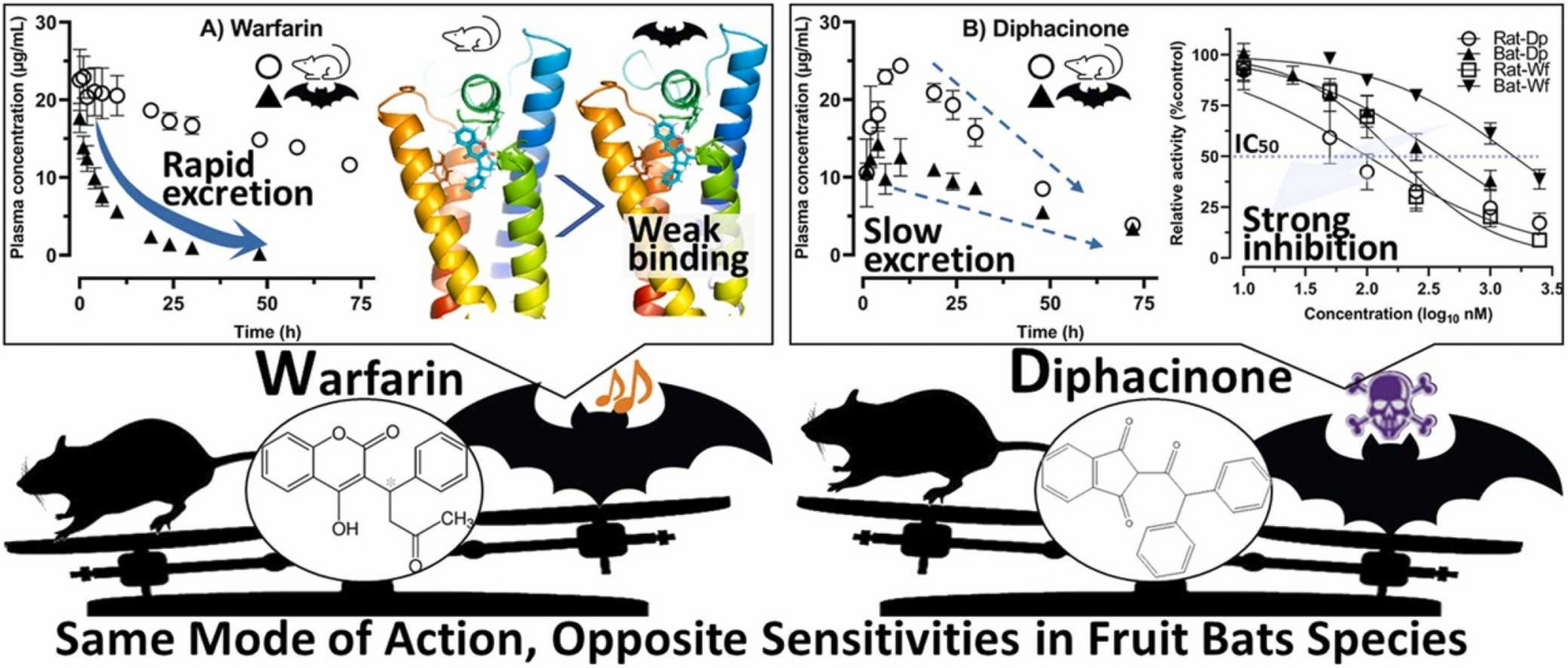
The most direct and conventional method for evaluating chemical susceptibility is to administer the compound to the animal and assess its toxic effects. However, toxicity testing cannot be conducted in the Bonin fruit bat, a critically endangered species found only in the Bonin Islands and represented by an extremely small remaining population.
To evaluate rodenticide susceptibility without harming Bonin fruit bats, our laboratory conducted a non-invasive toxicity assessment using genomic information and molecular simulation.
Using genomic DNA obtained from the Bonin fruit bat, we identified the gene sequence of vitamin K epoxide reductase complex subunit 1 (VKORC1), the target protein of anticoagulant rodenticides, by next-generation sequencing. We then constructed its three-dimensional protein structure using AlphaFold2 and computationally evaluated its interactions with rodenticides through molecular docking and molecular dynamics simulations.
Our analyses indicated that fruit bat species may show relatively low susceptibility to warfarin, a coumarin-type anticoagulant rodenticide, while showing greater susceptibility to diphacinone, an indandione-type anticoagulant rodenticide. These results demonstrate that even chemicals acting on the same target protein can exhibit distinct interspecies differences in susceptibility depending on their chemical structure.
Original Research Article
The findings of this study were published in the international journal Ecotoxicology and Environmental Safety.
Toxicokinetic analysis of the anticoagulant rodenticides warfarin & diphacinone in Egyptian fruit bats (Rousettus aegyptiacus) as a comparative sensitivity assessment for Bonin fruit bats (Pteropus pselaphon)
Kazuki Takeda et al.
Ecotoxicology and Environmental Safety, 243, 113971, 2022.
DOI:
https://doi.org/10.1016/j.ecoenv.2022.113971
The text and figures of this article are available under the Creative Commons Attribution-NonCommercial-NoDerivatives 4.0 International License (CC BY-NC-ND 4.0).
This research was supported by the Environment Research and Technology Development Fund (JPMEERF20184R02).
2. Are Black Rats on Chichijima Island Becoming Rodenticide Resistant?
Anticoagulant rodenticides are among the most widely used rodenticides worldwide. However, rodent populations with reduced susceptibility or resistance to anticoagulant rodenticides have emerged in many regions, making effective control increasingly difficult.
To evaluate whether invasive rodents in the Bonin Islands exhibit reduced susceptibility to rodenticides, we captured black rats (Rattus rattus) on Chichijima Island, the main island of the Bonin Archipelago, in 2022 and assessed their sensitivity to diphacinone using pharmacokinetic/pharmacodynamic (PK/PD) analysis.
Field Sampling of Black Rats on Chichijima Island

Field sampling of invasive black rats on Chichijima Island, Bonin Archipelago, Japan
Reduced Diphacinone Susceptibility without Known Resistance Mechanisms
Known mechanisms of anticoagulant rodenticide resistance include:
- Genetic mutations in VKORC1, the target protein of anticoagulant rodenticides; and
- Enhanced detoxification and metabolic capacity, including increased activity of cytochrome P450 enzymes.
However, the black rats captured on Chichijima Island did not carry mutations in Vkorc1, and their detoxification and metabolic capacity was comparable to that of susceptible black rats.
Despite the absence of these known resistance mechanisms, the Chichijima black rats showed a reduced anticoagulant response following diphacinone administration. The degree of reduction in blood coagulation response was comparable to that observed in VKORC1-mutant anticoagulant-resistant rats captured in Shinjuku, Tokyo.
These findings suggest that black rats on Chichijima Island may already exhibit reduced susceptibility to diphacinone despite lacking known rodenticide resistance mechanisms.
It is important to note, however, that this study evaluated pharmacokinetic and pharmacodynamic responses after a single administration of diphacinone. Determining whether these black rats are truly resistant to rodenticides, in the sense that they survive prolonged consumption of rodenticide bait, would require a dedicated toxicity study involving continuous exposure to rodenticide bait over several weeks.
Original Research Article
The findings of this study were published in the international journal Pesticide Biochemistry and Physiology.
Sensitivity assessment of diphacinone by pharmacokinetic analysis in invasive black rats in the Bonin (Ogasawara) Archipelago, Japan
This research was supported by the Environment Research and Technology Development Fund (JPMEERF20214R02).
Research Highlights
SETAC Award for Research on Diphacinone Susceptibility in Black Rats
Kotaro Tanaka, then a sixth-year undergraduate student in our laboratory, conducted this study as his graduation research project. He presented the findings at the 3rd Joint Conference on Environmental Chemicals, held in Hiroshima in July 2024, and received the SETAC Award.
Two Awards for Research on Rodenticide Sensitivity in Fruit Bats
Keita Shimizu, then a sixth-year undergraduate student in our laboratory, conducted research on rodenticide susceptibility in fruit bats as his graduation research project.
He received the Best Presentation Award at the 28th Annual Meeting of the Japanese Society of Zoo and Wildlife Medicine, held in Tsukuba in September 2022, and the Excellent Presentation Award from the Wildlife Science Section at the 165th Meeting of the Japanese Society of Veterinary Science, held online in September 2022.
Significance of This Research
The control of invasive rodents is essential for protecting the endemic ecosystems of the Bonin Islands. At the same time, rodenticide use must be carefully managed to minimize risks to non-target wildlife and to prevent the development of resistant rodent populations.
Our studies address both sides of this challenge:
- Protecting endemic wildlife by evaluating the rodenticide susceptibility of the critically endangered Bonin fruit bat without conducting invasive toxicity testing; and
- Maintaining effective invasive rodent control by monitoring potential reductions in rodenticide susceptibility in wild black rat populations.
By integrating genomic information, molecular simulation, in vivo pharmacokinetic and pharmacodynamic analyses, and comparative toxicology, our laboratory aims to establish scientifically grounded strategies for effective rodent control and wildlife conservation in fragile island ecosystems.
Sources of Header Images
Ogasawara Village Tourism Bureau
https://www.visitogasawara.com/photolibrary/
Ministry of the Environment, Japan
https://www.env.go.jp/nature/kisho/hogozoushoku/index.html